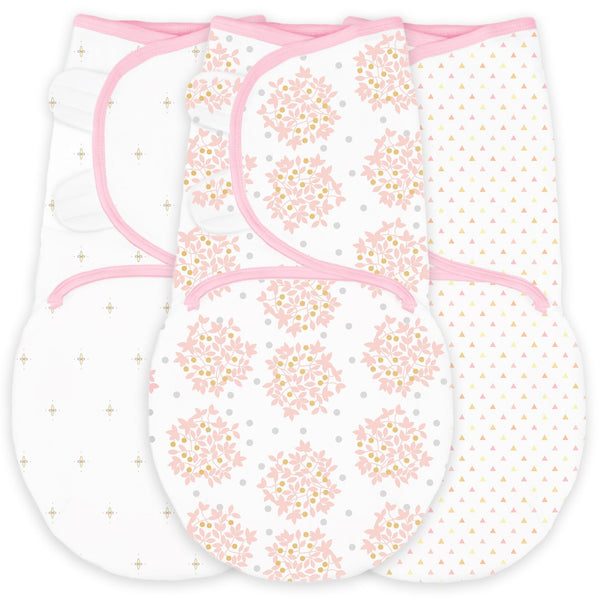

The Omni Swaddle Sack is a game changer for Better and Safer Sleep. The ideal swaddle for a newborn during baby’s first week might not be the best option for a baby at four weeks, and a swaddle that works for a baby who loves to be snug might not match another baby who sleeps better with their arms up. As babies grow and develop, and their preferences and support needs change during the first 12 weeks of life, a versatile swaddle that can adapt to their evolving needs is a game-changer for parents seeking better sleep.
This guide will explore the different swaddling needs of a baby from birth through the crucial rolling stage, highlighting how –theSwaddleDesigns Omni Swaddle Sack– stands out as the easiest and most versatile solution for the 4thtrimester. After reading this article, you will understand why many US hospitals have selected the Omni Swaddle Sack® to upgrade their safe sleep programs.
Let’s first discuss four stages that quickly unfold as parents navigate baby’s first 90 days and how the Omni Swaddle Sack helps support baby’s needs during each stage, and then, with a focus on better and safer sleep, we will compare two other popular swaddles.
Stage 1: The Newborn (The First 28 Days)
Newborns have a strong startle reflex (Moro reflex) and most crave the secure, womb-like feeling of being snugly wrapped. This is the stage where a traditional swaddle that keeps their arms snug and close to their body is most effective.
What baby needs:Snugly wrap baby’s arms close to their body to restrict arm movement to suppress the Moro reflex and support baby’s legs in a flexed position for healthy hip development. A swaddle that provides a secure, comforting feeling and suppresses the startle reflex by restricting arm and leg movement will reduce full awakenings caused by the startle reflex while supporting baby in a natural position.
How the Omni Swaddle Sack helps:The Omni Swaddle Sack’s 6-way design allows for a traditional, arms-snug-to-body swaddle. The half-length sleeves with mitten cuffs closed help parents manage baby’s arms when swaddling with baby’s arms on their chest and secured in this position with the adjustable wrap. The wrap provides a snug fit with hook-and-loop fasteners and the ergonomic sack design ensures the baby’s legs and hips are positioned correctly for healthy development.
Stage 2: The Evolving Baby (5-8 Weeks)
As a baby approaches five weeks, they start to reach out into their surroundings more, but still have a strong Moro reflex. Some babies at this stage begin to show a preference for having their hands near their face or their arms in a natural “up” position.
What baby needs:A swaddle that still offers a level of containment but also allows for more arm mobility. Some babies start to escape from other swaddles and free their arms to self-soothe by sucking on hand or sleep with arms up.
How the Omni Swaddle Sack helps:This stage is where the Omni Swaddle Sack’s uniquely shaped arms up sleeves with fold over mitten cuffs become a key feature. The patented design featuring the uniquely shaped sleeves offers a middle ground – the half-length sleeves with mitten cuffs closed provide partial suppression of the startle reflex while accommodating a baby’s natural desire for arm movement. Unlike other swaddles that fully restrict arm movement, the Omni Swaddle Sack’s sleeves allow a baby to extend their arms in a natural baby sleeping position with hands reaching above baby’s ears and allow baby to bring their hands to mouth to self-soothe. Baby feels secure because their arms are contained within the sleeves and can feel their surroundings. With the Omni Swaddle Sack, parents can swaddle baby with one arm (or both arms) up and outside the wrap, and the Omni’s sleeves with mitten cuffs closed provide partial suppression of the Moro reflex. Instead of a nightly struggle of multiple awakenings with baby wiggling arms out and hence, fully waking up, everyone will get more sleep.
Stage 3: The Self-Soother (8-12 Weeks)
Many babies discover their hands around eight weeks and begin to use them for self-soothing, a critical developmental milestone. They may suck on their fingers or rub their face to comfort themselves. A swaddle that completely restricts their hands can be a source of frustration and disrupt sleep.
What baby needs:A swaddle that allows them to access their hands for self-soothing while still providing a secure, calming environment.
How the Omni Swaddle Sack helps:The Omni Swaddle Sack’s sleeves are perfectly designed for this stage. The uniquely shaped arms-up sleeves allow babies to bring their hands to their mouth, satisfying their natural need to self-soothe, and at the same time, the sleeves with cuffs closed provide partial suppression of the Moro reflex when baby’s arms are up and outside the adjustable wrap. This is a significant advantage when compared to other products with “no” sleeves that offer little to no startle reflex suppression or products that fully restrict hands. The Omni Swaddle Sack provides the best of both worlds: it facilitates self-soothing and still offers enough containment to dampen the startle reflex. Plus, parents can open a cuff so baby can pacify directly on their hand.
Stage 4: The Roller (12+ Weeks)
Around the three-month mark, babies often become more active. They might begin to kick, roll from side to side, and show the first signs of wanting to roll over. This is the stage that the transition from a traditional swaddle becomes a safe sleep imperative.
What baby needs:A swaddle that offers the continued comfort of a snug fit but does not restrain arm movement should they unexpectedly roll to tummy with baby’s face down into the mattress. Because most babies start rolling before the startle reflex has faded, during this stage baby needs some help keeping their arms from wild flailing. Partial suppression is ideal during this stage, and at the same time it is critically important that baby has arm mobility to use their arms to self-reposition if baby rolls from their back to their tummy.
How the Omni Swaddle Sack helps:The Omni Swaddle Sack is designed to be a safe solution during the transition period. When baby starts to show signs of starting to roll over, the wrap should be secured around baby’s tummy and chest with arms out from under the wrap. The half-length arms up sleeves with mitten cuffs closed provide partial suppression of the Moro reflex. Its sleeves are uniquely shaped and half-length with arms-up, allowing for enough arm mobility for the baby to push up and reposition themselves if they were to roll onto their stomach. The innovative design means the Omni Swaddle Sack can be used safely even if baby starts to roll over, when used as described above. When baby starts to roll over, other swaddle products instruct parents to stop using their product, or swaddle baby with arms up and out, or remove the wings to convert to a sleeveless wearable blanket, and with these other swaddles baby’s arms will flail without any suppression and cause awakenings. The Omni Swaddle Sack is clearly the best swaddle when baby starts to roll over because of the patented “Little Sleeves with a Big Purpose.”
The Anatomy of the SwaddleDesigns Omni Swaddle Sack
To truly understand its versatility, it helps to visualize the Omni Swaddle Sack’s unique design. Unlike a traditional blanket swaddle, it is a garment that babies wear. It has a sack-like bottom for the legs and torso, and a central 2-way, 2 pull zipper for easy entry and easy diaper changes. But what sets it apart are the specially shaped, arms up, half-length sleeves with fold-over mitten cuffs and a narrow adjustable wrap panel.
The Arms Up Sleeves:These sleeves are the special and unique feature and the heart of the Omni Swaddle Sack’s adaptability. The sleeves are uniquely shaped so arms can extend up beyond baby’s ears in a natural sleeping position. The sleeves are not full-length and have mitten cuffs that open and close. The sleeves allow for various arm positions, including hands on baby’s chest, arms up with hands above baby’s ears, and hands near baby’s mouth for self-soothing. The foldover cuffs when closed provide a partial suppression of the Moro reflex when baby’s arms are outside the wrap. The mitten cuffs cover baby’s hands when the cuffs are closed, and the cuffs can be opened when a baby wants to self-soothe by sucking on their hands. Most parents prefer cuffs to be closed to protect baby’s face from scratches and provide partial suppression of the startle reflex. This is a design feature not found on other swaddles.
The Narrow Wrap Panel:The narrow adjustable wrap panel can be fastened snugly over arms and around the baby’s torso, providing the secure feeling of a traditional swaddle. This wrap is a key component for newborns who need full containment. The narrow design of this wrap is superior to others on the market because it allows parents to check and change baby’s diaper without unwrapping baby. Other products with a hook-and-loop or Velcro® wrap panel require parents to unwrap baby to check the diaper. In addition, the narrow wrap panel is designed not to interfere with the baby’s hips, promoting healthy hip development. The Omni Swaddle Sack is recognized as Hip Healthy by the International Hip Dysplasia Institute.
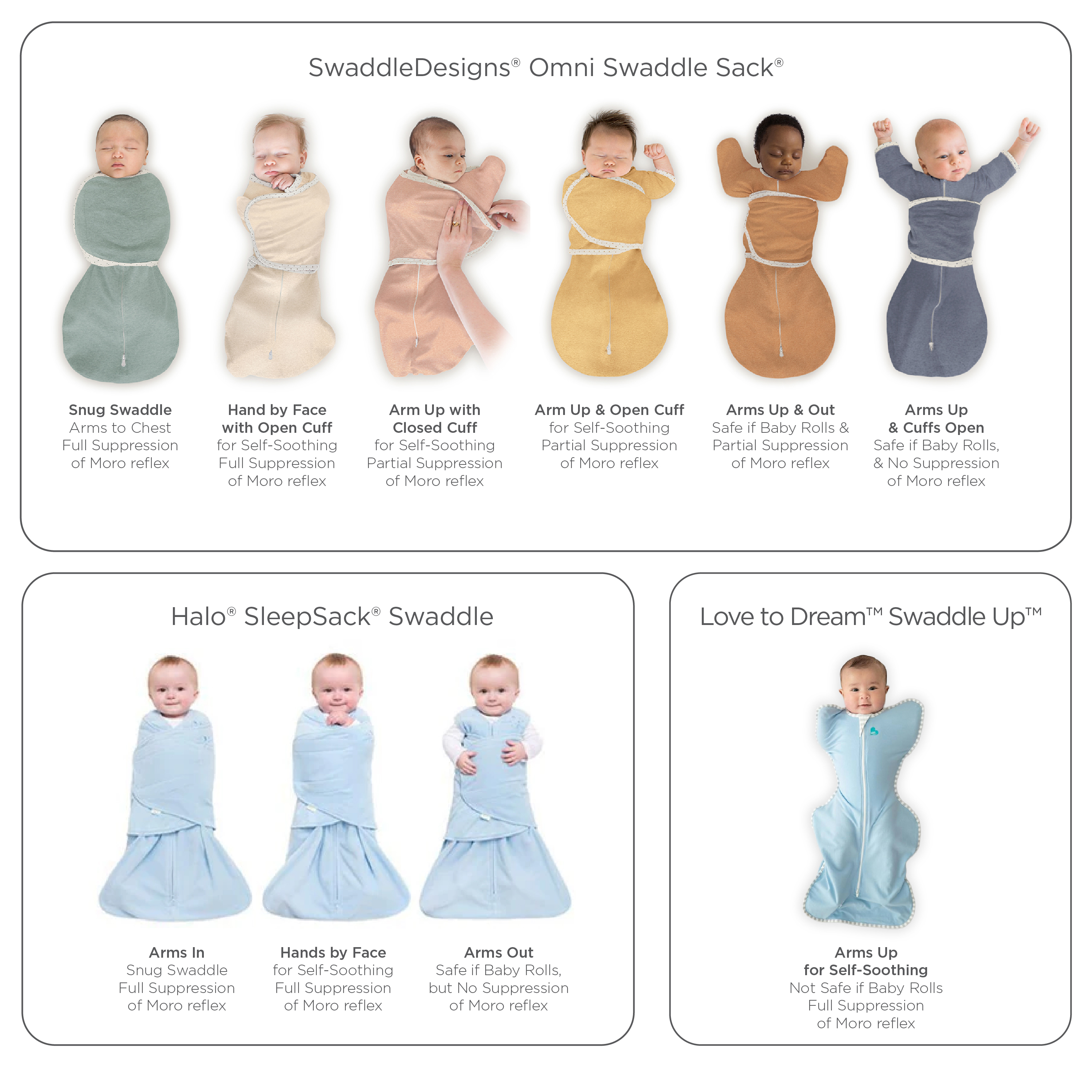
To illustrate these differences, consider the Omni Swaddle Sack design compared to these two popular swaddles:
The Halo SleepSack Swaddle includes a wide wrap that extends past the baby’s hips and knees, while the Love to Dream Swaddle Up features small “bump out” shapes by the shoulder region with limited arm mobility that keeps hands close to baby’s face. In contrast, the Omni Swaddle Sack combines a narrow wrap with unique arms-up sleeves, creating a hybrid swaddle that is more versatile across all stages. The Y-shaped sleeves with mitten cuffs of the Omni Swaddle Sack provide security, comfort and partial startle reflex suppression when the cuffs are closed, and the other “no sleeve” swaddles provide full suppression or no suppression.
Comparison to Other Swaddles
When looking at the market, products like the Halo® SleepSack® Swaddle and the Love to Dream® Swaddle Up address some of baby’s needs during the first 12 weeks but lack the comprehensive versatility of the Omni Swaddle Sack.
Halo SleepSack Swaddle:The Halo is a sleeveless sleep sack with an adjustable wrap, which can be used for a traditional arms-in swaddle or arms-out. However, when used with arms-out, it provides no arm containment or startle reflex suppression, and this “all or nothing” approach can be difficult for a baby, and difficult for parents due to baby’s awakenings caused by the startle reflex.
Love to Dream Swaddle Up:The Swaddle Up’s primary feature is its small bump outs in the shoulder region that contain baby’s arm movement but keeps hands by face to allow a baby to reach their mouth with their hands, which allows babies who naturally prefer this position and want to self-soothe to suck on their hands. However, the Swaddle Up lacks the ability to offer a traditional, snug, arms-in/arms supported swaddle for newborns who need that extra level of containment, and if baby rolls over, it does not offer enough arm mobility for baby to push up. And, the Swaddle Up offers no way to transition when baby starts to roll over. It can only be safely used up until baby starts to show signs of rolling over due to the limited arm mobility of its design.
The Ultimate Choice for the First 12 Weeks
TheSwaddleDesigns Omni Swaddle Sackis the most versatile solution for baby’s ever-changing needs during their first 12 weeks of life. It seamlessly adapts from a snug newborn swaddle to a versatile solution that accommodates a baby’s growth and development for arms-up sleep and self-soothing and makes it easy for parents to navigate the swaddle transition stage, all while providing a safe and comforting environment.
The Omni Swaddle Sack was designed by Lynette Damir, RN, an experienced mom and baby product developer. As the founder of SwaddleDesigns, Lynette was inspired to design a swaddle that was more versatile than the current solutions with a focus on ease of use and allowing parents to easily accommodate each baby’s unique preferences as they develop and grow. Lynette’s Omni Swaddle Sack design has been granted multiple awards and patents in the US and around the world. And the Omni has become the preferred swaddle sack for major US hospitals looking to update their Safe Sleep programs.
By choosing a swaddle that evolves with your baby, you can avoid having to buy multiple products as their developmental needs and preferences change. The Omni Swaddle Sack provides a single, smart solution that supports safe and comfortable sleep through a baby’s most dynamic period of development.
Conclusion and Recommendation
In my 18 years as a children’s sleep consultant, I’ve seen many swaddles come and go. Parents will often ask me which one to buy, and my answer used to depend on their age and temperament. Not anymore.
The Omni Swaddle Sack is the first product I can recommend from a baby’s first day through the rolling stage. Its design addresses the real issues I see with families every week. Parents often buy several swaddles, babies resist arms-in swaddles around six weeks, and families feel anxious when rolling starts and they’re unsure how to transition safely.
The Omni Swaddle Sack stands out for more than just its versatility, though that alone makes it a good choice. It’s clear the swaddle was designed by someone who understands both how babies develop and how tired parents feel. You can adjust it as your baby grows, help your baby self-soothe while reducing the startle reflex, and use it safely as rolling begins. These features make a real difference and help everyone sleep better. If you’re expecting or have a newborn, do yourself a favor and skip the trial-and-error phase. Start with the Omni Swaddle Sack and give yourself one less thing to worry about during those intense first months.
Rebecca Michihas been achildren’s sleep consultantsince 2008. She focuses on compassionate practical and proven techniques that help the whole family get more sleep.
By Desiree Baird, Certified Infant and Child Sleep Consultant
In 2016, when the American Academy of Pediatrics SIDS Task Force updated and published their Safe Sleep Recommendations, one of the new recommendations frustrated parents, because the AAP statement advised parents to stop swaddling their baby with baby’s arms fully restrained when baby showed signs of starting to roll over onto their tummy. This “ready to roll over” milestone usually happens around 3-4 months, but it can happen sooner.
The AAP encouraged parents to use a wearable blanket, also known as a sleep sack, when baby showed signs of starting to roll over. Unfortunately, many parents struggled to get sleep because their baby did not sleep well in a sleeveless wearable blanket. And as all parents know, when baby is not sleeping well, no one sleeps well.
Sleep deprivation is the #1 complaint of new parents because it is a common problem that negatively impacts the whole family. The AAP recommendation to stop swaddling when baby showed signs of attempting to roll over, impacted many parents and they began voicing their frustration on social media and to sleep consultants. It became increasingly clear that parents were struggling to get a goodnight’s sleep, because babies who are starting to roll over, typically still have a strong Moro reflex, so they don’t sleep well in a sleeveless wearable blanket due to awakenings caused by the startling and flailing arm movements.
As the founder of SwaddleDesigns, Lynette Damir, RN, had been developing safe sleep products, and supporting parents for many years. She listened to sleep deprived parents’ frustrated voices as they shared their challenges related to the AAP’s recommendation to stop swaddling when baby showed signs of starting to roll over, and she listened to parents who shared situations where they made unsafe sleep decisions out of desperation for sleep.
Lynette Damir, RN, identified and named “The Transition Stage” - the time period when caregivers need to stop swaddling their baby because their baby starts to show signs of rolling over and prior to the time when baby is able to sleep well in a wearable blanket. During the Transition Stage, babies still experience a strong Moro (startle) reflex and they are able to roll over from back to tummy. The Transition Stage can last for many weeks or months.
When baby is showing signs of starting to roll over, it is very important to stop swaddling with their arms fully restrained inside a swaddle, especially if baby has their arms swaddled down by their sides. If baby’s arms are fully restrained by the swaddle, there is no way for baby to use their arms to push their torso up and reposition their head to get access to air if they were to roll over onto their stomach and land face down on the mattress. A baby who has rolled onto their stomach with arms fully restrained inside a swaddle is at risk of suffocation.
In the year following the AAP’s 2016 recommendation, as evidenced by the social media chatter and comments made by sleep consultants, there were many examples of parents talking about baby not sleeping well in a loose-fitting sleep sack due to a strong startle reflex, and many parents shared what they were doing to get their baby to sleep. For example, some parents shared that they kept swaddling their baby for sleep well after their baby could roll over onto their tummy, and some parents admitted that they started bringing baby to sleep in the parents’ bed with them, and some parents shared that they would fall asleep holding their baby in a recliner. All of these choices increase the risk of suffocation, SIDS, and SUIDS. All of these choices are defined by the AAP as risky and unsafe. Most of the parents were aware that they were making a risky choice, but when parents are sleep deprived, the need for sleep can lead to unsafe choices.
Lynette was concerned, because the parents were justifying their unsafe decisions out of desperation, because their baby was not sleeping well during this transition time. Lynette learned that the Transition Stage could span the period from when baby is two months old to six or seven months old. In some cases, lasting several months which is too long for parents and babies to struggle for sleep, tough it out, and get sleep deprived by trying cold turkey methods.
At that time, the most common expert advice was to use the old “cold turkey” method when it was time to stop using a snug swaddle. When parents stop swaddling abruptly it is commonly referred to as going “cold turkey.” Taking a ready-to-roll baby out of their comfy swaddle, which has full suppression of the Moro reflex, and placing them in a sleeveless sleeping sack with no suppression of the Moro reflex, can wreak havoc for baby and family, because baby, who was sleeping well in the swaddle with full suppression of the Moro reflex, will start waking up many times a night caused by the Moro reflex and the Moro-related flailing arms.
The old “cold turkey” method includes techniques such as abruptly stopping swaddling and start using a sleeveless sleep sack with no Moro suppression. Another example of a “cold turkey” technique is to try to wean baby from the swaddle by swaddling with one arm out, and then the other. But it can take weeks, sometimes months, for baby to adjust. One arm outside the swaddle is not necessarily safe or effective. Many sleepless nights can be involved, where parents and baby both struggle for sleep. Some parents used “cry it out methods” during this time as well, which is not gentle on anyone’s nervous system.
The Moro reflex usually starts to fade around 4-6 months. But baby may roll over at 2-3 months. The peak age of SIDS/SUIDS is around 2-4 months, so the Transition Stage time period is a big deal. It’s a really important time period to use safe sleep practices. Parents and babies need support. With proper support, baby can transition from the swaddle to the wearable blanket in a safer way and without sleep deprivation.
Lynette understood the problem and she could see that struggling parents needed a solution. She was determined to design a safe sleepwear product for the Transition Stage - a baby sleep garment for the time period when baby was showing signs of starting to roll over that simultaneously helped partially suppress the Moro reflex and would allow enough arm mobility for baby to use their arms to push their torso up and reposition their head to get access to air, if baby were to roll over.
Over a period of many months, Lynette developed the most important innovation in baby safe sleepwear in the past 10 years.She named her innovation the SwaddleDesigns Transitional Swaddle Sack. She used her healthcare and design backgrounds, her experience as a mom, and her years as the product developer for SwaddleDesigns to create a solution that has become the #1 transition swaddle with a worldwide portfolio of patents and awards. The design features specially-shaped, arms up, half-length sleeves with foldover mitten cuffs.
The SwaddleDesigns Transitional Swaddle Sack helps support baby in a gentle way because the uniquely designed, specially shaped, arms up, half-length sleeves provide partial suppression of the Moro reflex when the mitten cuffs are closed. If baby starts to wake, their arms don’t flail. Baby can feel their surroundings, feel secure and fall back to sleep.
Most importantly, if baby rolls over onto their tummy, the sleeves allow enough mobility for baby to push up to self-reposition their head to access air. When a baby is strong enough to roll over, baby has the arm strength to push their torso up and reposition their head. During the design process, the length of the sleeves was optimized to provide enough arm mobility to allow baby to use their arms. If the sleeves were shorter, then the sleeves would limit arm mobility too much and hold the arms in too close to their body to get the leverage needed to push up. If the sleeves were longer, then the sleeves would provide less suppression of the Moro reflex. After many iterations, Lynette’s sleeve design was finalized with the ideal shape and the perfect length to provide partial suppression when the mitten cuffs are closed and allow enough arm mobility to keep baby safe if baby rolls over to tummy.
The SwaddleDesigns Transitional Swaddle Sack is a game changer and an important innovation in the baby safe sleepwear pathway. It’s not a swaddle and it’s not a simple sleep sack. The Transitional Swaddle Sack is the bridge between swaddle and sleeping sack. It fills a need. It bridges a gap in safe sleepwear that was not met before. Babies sleep better and safer in the Transitional Swaddle Sack.
The little sleeves have a big purpose. When both cuffs are closed, the half-length sleeves (not merely enclosed bump outs for just the hands), provide partial suppression of the Moro reflex, so baby sleeps better, AND the sleeves allow enough arm mobility such that if baby rolls over onto tummy, baby can use their arms to push up to lift their torso and head to self-reposition to access air.
As parents navigate the Transition Stage, the foldover mitten cuffs may be closed to provide the partial suppression of the Moro reflex or be opened to allow baby to self-soothe by sucking directly on their hand. Many parents like to keep the mitten cuffs closed to protect baby from facial scratches and keep baby’s arms and hands warm.When baby is no longer experiencing the Moro reflex, both cuffs can be opened to allow baby to have full range of motion with their arms.When baby is sleeping well with both cuffs open, then baby can continue to wear the TSS as a sleeping sack and baby is ready to wear a sleeveless wearable blanket.
SwaddleDesigns offers the Transitional Swaddle Sack in three sizes because many babies sleep better with the uniquely shaped sleeves over many months. It is important to select a size based on baby’s weight to ensure a good fit where baby benefits from the partial suppression.
The Transitional Swaddle Sack is not a swaddle with full suppression of the Moro reflex. Nor is it an “All or None” convertible product. “All or None” products, as they are called by sleep consultants, are products where the parents zip off bump outs for hands or zip off “wings” to convert the garment from a swaddle with full suppression of the Moro reflex to a sleeveless wearable blanket with no Moro suppression.
The “All or None” convertible products do not support baby during the Transition Stage because they rely on the old cold turkey techniques, and they are not safe to use with wings zipped on when baby is showing signs of starting to roll over or can roll over. The “All or None” convertible products are risky for a baby who is able to roll, because the parent may decide to revert to the arm restricted configuration, if baby is not sleeping well when the arms are fully free.
To transition from a swaddle that fully restrains both arms, most convertible products advise parents to swaddle with one arm out and then two arms out as a transitioning strategy, but this must be done early before baby is even showing signs of rolling over to be safe. This approach is not gradual or gentle in practice and is a form of the old outdated cold turkey approach that parents have learned does not work for most babies.
The SwaddleDesigns Transitional Swaddle Sack is unique and thoughtfully designed for this very challenging time when baby is transitioning from a swaddle, but is not ready to sleep well in a sleeveless wearable blanket because it simultaneously provides partial suppression of the Moro reflex and enough arm mobility if baby were to roll over onto tummy.
After SwaddleDesigns introduced the Transitional Swaddle Sack, as parents started telling other parents, soon after, competitive baby product companies noticed, and they added the word “Transition” to their product titles. It is important for parents to be aware that there are many copy-cats claiming to be a transition swaddle, but these so-called transition swaddles are really convertible “All or None” products that do not offer partial suppression of the Moro reflex when configured for a baby who can roll over. These so-called Transition Swaddles from other brands are not designed to be simultaneously safe for a rolling baby while providing partial suppression of the Moro reflex.
Today, thanks to the SwaddleDesigns Transitional Swaddle Sack, parents and babies can move through the Transition Stage without a struggle, and there is no need to use the old “cold turkey” techniques. Thousands and thousands of parents have commented that the Transitional Swaddle Sack helped their baby sleep after struggling with other products, and many described the Transitional Swaddle Sack as a lifesaver.
It is important to highlight that the Transitional Swaddle Sack design was granted multiple US and international patents, and it is recognized by the International Hip Dysplasia Institute as Hip Healthy.
This Transition Stage is a critical time, because it is known as peak time for SUID and SIDS. And when parents are desperate for sleep, parents can make risky or unsafe choices. Instead of just telling parents to stop swaddling and hoping that their baby will sleep well, Lynette used her expertise to create a solution that helps babies sleep well and sleep safely.
As a sleep consultant, I am very aware of all the available options on the market. For completeness, I have listed the other options and why I do not recommend these products:
·Love to Dream Transition Bag is an “All or None” convertible product that can be configured to be a swaddle or a sleeveless sleeping sack. It requires the parent to make the choice to unzip and remove wings when baby is showing signs of rolling over. With wings removed, it provides no suppression of the Moro reflex. It is a “cold turkey” solution, offering no support during the Transition Stage.
·Halo Easy Transition Sack is a sleeping sack with a ¾ length sleeves and extra fabric that provides negligible Moro suppression during the Transition Stage. It is easy to use and safe if baby rolls over, but given the lack of Moro suppression, is not a good option for the Transition Stage.
·Merlin Magic Sleepsuit is a padded sleep suit that minimally restricts baby’s arm movements, and the manufacturer recommends parents to stop using when baby is able to roll. Not a viable option for the Transition Stage.
·Sleeping Baby Zipadee Zip with the flying squirrel design keeps baby’s arms and legs fully enclosed and provides minimal if any suppression of the Moro reflex during the Transition Stage. It is easy to use and safe if baby rolls over. Given the lack of Moro suppression, the Zipadee Zip is not the best option for the Transition Stage.
As a sleep consultant helping new parents, I advise families to use the SwaddleDesigns Transitional Swaddle Sack, and I encourage expecting parents to add the TSS to their baby registry. When it is time to stop swaddling, the Transitional Swaddle Sack is the ideal baby sleep product that helps baby sleep better, longer, and safer.
The Transitional Swaddle Sack has climbed the bestseller chart to become the #1 transition swaddle on Amazon. The bestseller status is clear evidence that the TSS is a parent favorite. There are thousands of consumer reviews on Amazon. The consumer reviews on Amazon include objective user assessments that can help new parents, sleep consultants, researchers, and newborn care educators better understand how the Transitional Swaddle Sack performs.
Here is a summary of the key points highlighted in this article:
·When baby starts showing signs of attempting to roll over, the AAP strongly recommends that parents stop swaddling with arms fully restrained
·Babies usually start rolling over around 3-4 months, and as early as 2 months.
·Many babies who are able to rollover still have a strong Moro (startle) reflex that causes baby’s arms to flail and causes awakenings.
·Research has shown months 2-4 is the peak time of SUID and SIDS, so it is important for parents to be vigilant and follow safe sleep recommendations
·Lynette Damir, RN, founder of SwaddleDesigns, named the Transition Stage as a stage between the Swaddle Stage and the Sleep Sack Stage.
·The Transition Stage is a developmental period when baby is able to roll over, but still is experiencing the Moro (startle) reflex.
·Many babies don’t sleep well in a sleeveless wearable blanket during the Transition Stage because they still have a strong Moro reflex.
·Some babies don’t sleep well when abruptly stopping swaddling with full suppression of Moro reflex to wearing a sleeping sack with no suppression of Moro reflex.
·The Transition Stage doesn’t have to be a time of struggle leading to sleep deprivation, because parents can use the SwaddleDesigns Transitional Swaddle Sack.
·During the Transition Stage, the SwaddleDesigns Transitional Swaddle Sack® helps babies sleep better and safer, because of the patented arms up half-length sleeves with foldover mitten cuffs closed provides partial suppression of Moro reflex, and simultaneously, the design provides arm mobility, allowing baby to use their arms to self-reposition if baby rolls over.
Desiree Baird is an internationally certified infant and child sleep consultant working with children from newborn through 5 years of age. She provides compassionate, personalized sleep support for families. For more information, please visit Pediatric Sleep Coach.
A great opportunity to save on newborn necessities, infant sleepwear, swaddles, burp cloths, baby sleep sacks, swaddle wraps and sleeping sacks. Stroller blankets, hooded towels and washcloths, and baby apparel.