









Better, Safer Sleep for Mom and Baby
Over the past year, many hospitals have updated their Safe Sleep programs to include in-hospital modeling of safe sleep and a take-home gift like a swaddling sack that helps the parents swaddle at home. This approach, combined with improved Safe Sleep educational material, increases the likelihood that new parents will recall, understand, and use safe sleep guidelines when they return home.
Recently, many hospitals have decided to refresh and update their Safe Sleep program by selecting the SwaddleDesigns Omni Swaddle Sack. They realize that parents are overwhelmed with emotion during their hospital stay, and it is very important to extend the educational program to the home. By providing an Omni Swaddle Sack as a take-home gift, they are providing the most versatile swaddle and visual reminder of the hospital safe sleep educational material.
The programs are designed to educate parents about the American Academy of Pediatrics (AAP) Safe Sleep Guidelines and teach important newborn calming techniques including how to swaddle, so everyone can get more sleep. The goal is to empower parents with useful skills and tools, to minimize the probability that the parents will become overly fatigued and sleep deprived.
Sleep deprivation
Families where the baby is not sleeping well, struggle, because when baby is not sleeping well, nobody sleeps well. New parents need to learn how to properly swaddle a baby, because swaddling reduces the likelihood the baby will wake due to the Moro (startle) reflex. Studies have proven that swaddled babies sleep longer and better.
Sleep deprivation and exhaustion are the primary complaint of new parents and experts understand that parent sleep deprivation can lead to unsafe choices, increased postpartum depression and shaken baby syndrome.
Exhaustion combined with a crying baby impairs judgement and can lead parents to make unsafe choices such as bringing baby to bed with them, which significantly increases the risk of suffocation and SIDS. Or, they might opt to put baby on their stomach, which also significantly increases the risk of SIDS.
Given that 3,500 babies die annually in the United States as a result of SIDS, SUID, and suffocation, it is extremely important for hospitals to implement programs that reduce the likelihood that a parent will make unsafe sleep choices. While there is no way to prevent SIDS, there are AAP guidelines designed to reduce risk of SIDS, SUID and suffocation.
In-hospital modeling of Safe Sleep practices
Studies have shown that parents remember and mimic what nurses do at the hospital, and hence, hospitals understand that modeling safe sleep behaviors and using an easy, safe swaddling approach is important.
As a result, many hospitals implement Safe Sleep Modeling Programs in the birth center and NICU. Staff training is a critical element of the program. In addition to educational material provided to parents, the Safe Sleep programs often include swaddling blankets or swaddling garments as departure gifts.
In many hospitals, babies are placed on the mother’s chest for the first hour or two, and then swaddled to give the mother a break and help with temperature regulation as the baby transitions from the womb to the world.
Many hospitals have stopped using traditional hospital swaddle blankets to instead swaddle newborns in wearable blankets with swaddle wraps to make it easier and safer for new parents.
At a multitude of hospitals, for example, every infant is wrapped with an Omni Swaddle Sack after birth. The Omni Swaddle Sack - In-Hospital Use (IHU) version is used to swaddle the baby while in the hospital, and the discharge nurse gives an Omni Swaddle Sack as a departure gift to the parents.
This program aligns with extensive education, in-hospital modeling of proper swaddling techniques and participation in programs such as the National Safe Sleep Certification program.
“Nurses are viewed as experts, so it is important that they are following the safest sleep practices possible and modeling what parents are learning in the educational materials they provide to parents,” says Lynette Damir, RN, founder of SwaddleDesigns.
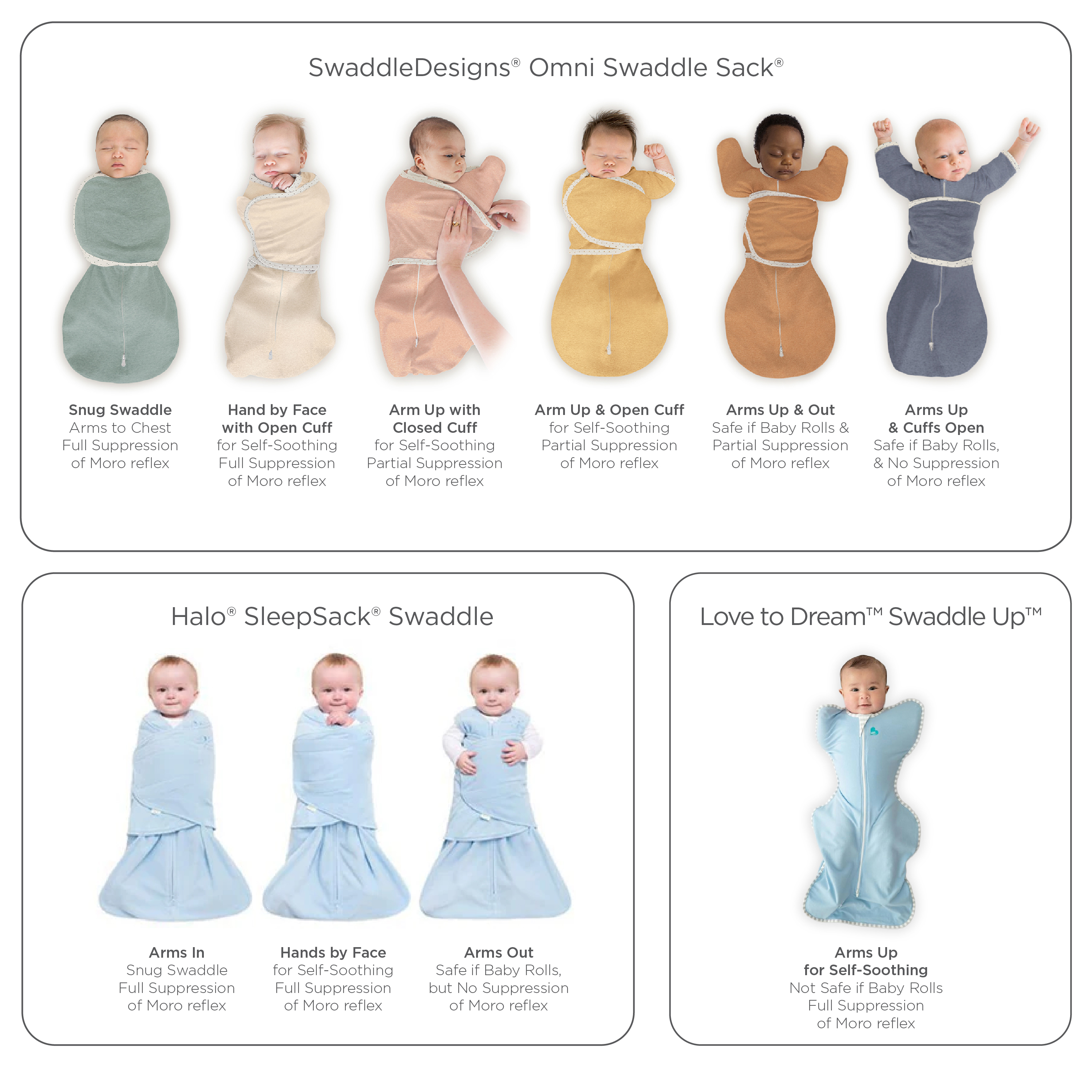
Designed by Lynette Damir, RN, the Omni Swaddle Sack is the most versatile swaddle and supports many natural arm and hand positions from birth through the rolling stage. The product is designed with specially shaped, arms-up, half-length sleeves with foldover mitten cuffs that, when open, allow baby to self-soothe and, when closed, protect against facial scratches. The product includes an easy to adjust wrap secured by hook-and-loop fasteners.
The sleeves are slightly shorter than a typical sleeve, so when the mitten cuffs are closed it holds the baby’s arms close to their body. If the baby prefers one or both arms up, then the sleeves cover the baby’s arms.
To support hospital safe sleep initiatives, SwaddleDesigns offers a special version of the Omni Swaddle Sack for in-hospital use, which has a longer wrap and does not use hook-and-loop fasteners. Nylon snaps are used instead of a zipper, to allow hospital personnel to x-ray without undressing the baby.
Safe Sleep education
In addition to modeling swaddling techniques, education plays a critical role as well. Hospitals provide written and verbal instructions on Safe Sleep guidelines. The Omni Swaddle Sack packaging includes helpful safe sleep and safe swaddling information
Hospitals are also updating their Safe Sleep educational materials to include the “3 Stages of the Safe Sleepwear” framework to help parents understand the importance of the transition stage between swaddling and the time baby is ready for loose, wearable blankets.
It is important that baby continue to sleep well during this transition time. The AAP recommends parents stop swaddling baby with arms restrained at 2-3 months or when baby shows signs of attempting to roll over.
However, at three months of age, some babies are not ready and do not sleep well in the looseness of a wearable blanket and still need some suppression of the Moro reflex. When baby is not sleeping well, parents are more likely to try unsafe sleep practices such as continuing to swaddle or bringing baby to bed with them, which increases the risk of SIDS, SUID, and suffocation
A SwaddleDesigns Transitional Swaddle Sack can help parents navigate this difficult period. A snug fitting design that partially suppress the Moro reflex, but the patented design allows sufficient range of motion for baby to use his or her arms to lift their torso and reposition their head, if he or she rolls over.
Departing gifts
SwaddleDesigns is honored to be selected as the departure gift by many small hospitals and major hospital groups, because Safe Sleep Programs impress upon parents how vulnerable babies are when they first go home, and why it is so important to keep the environment as safe as possible.
Through education and modeling of Safe Sleep techniques, along with a departure gift that matches what was used by the nursing staff, hospitals will reinforce what parents learned so that it can be properly applied in the home.
In doing so, baby is safer and sleeps more soundly. So will parents, who armed with better tools, will get more sleep and struggle less and make better choices. Ultimately, Safe Sleep Programs save lives.
Learn more about our Safe Sleep Programs for Hospitals
Please contact us at 855-SWADDLE or Hospital-info@SwaddleDesigns.com